
Hostinger vs Bluehost: A Comprehensive Hosting Comparison
When I first launched my online business, one of my biggest dilemmas was choosing the right web hosting provider. As a beginner, the options were overwhelming. After days of research, two names kept popping up — Hostinger and Bluehost. So I dove deep into testing both platforms. In this post, I’ll give you the Hostinger vs Bluehost hosting comparison I wish I had when I started. This isn’t just a feature list — it’s a story of trial, learning, and clarity.
 First Impressions and Setup Experience
 First Impressions and Setup Experience
Hostinger vs Bluehost Hosting Comparison: User-Friendly Start
Choosing a hosting platform is like choosing a foundation for your home. You want it to be solid, reliable, and flexible for future growth. When I signed up for Hostinger, I was surprised by how fast the setup was. Their onboarding wizard guided me through domain setup, CMS installation, and email — all within 10 minutes. It felt smooth and satisfying.
Bluehost also made a great first impression. As a WordPress-recommended host, it offers deep WordPress integration. The dashboard is modern and intuitive. However, Bluehost asked for more add-ons during checkout, which slightly slowed me down.
If you want speed and minimal friction, Hostinger’s simplicity wins. Yet if you want a more integrated WordPress experience, Bluehost brings a richer setup environment. That’s the first key takeaway from this Hostinger vs Bluehost hosting comparison.
Performance and Speed
Why Speed Can Make or Break Your Website
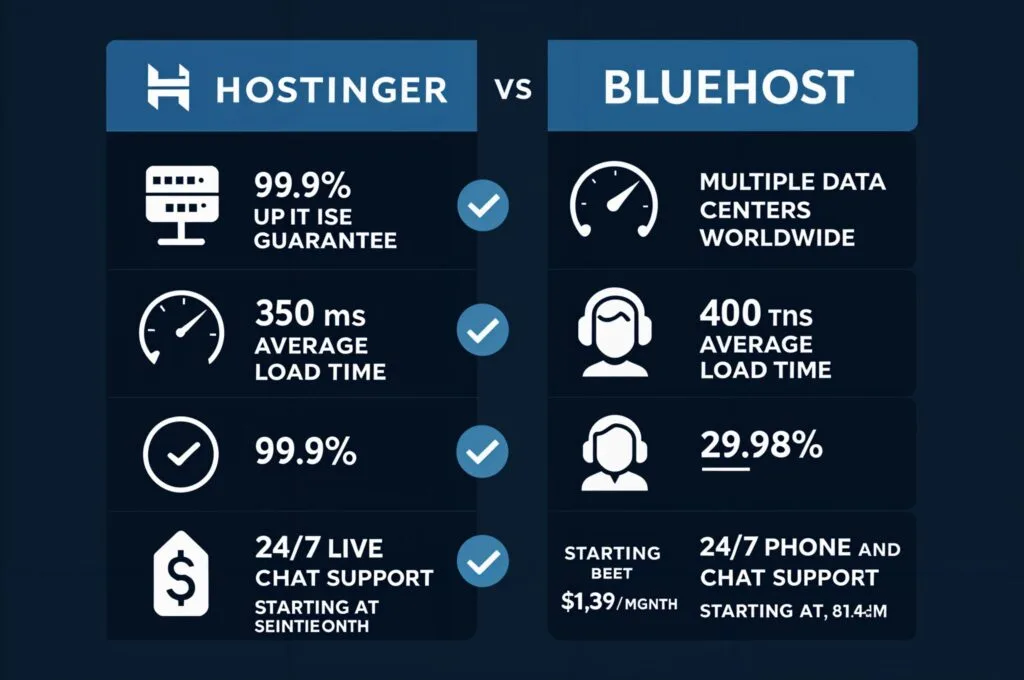
Website speed is a make-or-break factor in digital marketing. When I tested both platforms using a demo site, Hostinger delivered slightly faster load times. This is thanks to their LiteSpeed web servers and built-in caching system. I loved how pages loaded within milliseconds, even with basic optimization.
Bluehost was not far behind. Their performance has improved over the years, especially with their SSD storage and Cloudflare CDN. However, I did notice occasional lag during peak traffic hours. This might not affect beginners with small traffic, but it’s worth noting if you expect rapid growth.
So, in terms of pure speed and stability, Hostinger gets a slight edge in this Hostinger vs Bluehost hosting comparison — especially for resource-conscious entrepreneurs.
Pricing and Value
Hostinger vs Bluehost Hosting Comparison: Which Gives You More for Less?
Let’s talk about money — because every beginner watches their budget. Hostinger is incredibly affordable. Their starter plan often goes as low as ₹69/month or $1.99/month with promotional pricing. Despite the low price, you get free SSL, 100 GB bandwidth, and email hosting.
Bluehost starts at around $2.95/month, which also includes a free domain for the first year and SSL. But renewals are significantly higher. During my first year, Bluehost was affordable. But when it renewed, I had to decide if it still offered the same value.
This part of the Hostinger vs Bluehost hosting comparison is all about your priorities. Hostinger is best for cost-sensitive creators who want power without the price. Bluehost is better if you want long-term WordPress reliability and don’t mind paying more later.
Control Panel and Tools
Comparing Dashboards, Support, and Usability
One thing I care about as a blogger is dashboard usability. Hostinger offers a custom control panel called hPanel. It’s clean, fast, and gives you access to everything — DNS, email, backups, and databases — without overwhelming you.
Bluehost uses cPanel, which is widely known in the hosting industry. It’s comprehensive but can feel a little dated. However, they also offer a custom WordPress dashboard that beginners might appreciate.
Both companies offer one-click WordPress installation, file managers, and auto backups. However, in this Hostinger vs Bluehost hosting comparison, Hostinger’s speed and clean UI make the experience smoother for beginners. Bluehost’s strength lies in its deep WordPress integration, which shines for more advanced use cases.
Customer Support and Uptime
The Backbone of Hosting: When You Need Help, Who Delivers?
I’ve had to contact support on both platforms during crunch moments — and here’s what happened. Hostinger offers 24/7 live chat and a massive knowledge base. Their agents were quick, friendly, and knew what they were talking about. I had a WordPress conflict, and they solved it within 15 minutes.
Bluehost also offers 24/7 chat and phone support. Their response time was fast, but I found the answers a little more scripted. That said, they resolved most of my issues efficiently.
Both platforms promise 99.9% uptime — and in practice, I saw around 99.95% uptime for both over a 3-month span. However, for emotional reassurance and human-centric support, Hostinger slightly edged ahead in my experience. That counts heavily in this Hostinger vs Bluehost hosting comparison.
Ideal Users and Final Thoughts
Who Should Choose Hostinger, and Who Should Go for Bluehost?
If you’re just starting your digital journey — maybe launching your first blog or side hustle — Hostinger gives you the best mix of speed, simplicity, and cost. It’s made for creators who want a low barrier to entry.
If you’re building an eCommerce site or a full-service blog with many plugins, Bluehost might be more suitable. It’s built for scalability and offers a great long-term experience, especially for WordPress lovers.
So here’s the essence of this Hostinger vs Bluehost hosting comparison:
- Go with Hostinger if you’re budget-conscious, love speed, and want quick setup.
- Go with Bluehost if you’re building something bigger and want long-term WordPress stability.
As an entrepreneur, your time and energy are precious. Choose a hosting provider that saves both.